Solving for S
Most organisations are doing more good than they can prove. Organisational intent is genuine. Investment is significant. What has been missing is a single independent standard capable of assessing social impact at enterprise level — across the whole system, in a decision-useful form that boards, investors, accountable executives and regulators can rely on.
That standard now exists.
A peer-reviewed, evidence-based assessment standard — 9 pillars · 30 domains · 170+ indicators — aligned with the International <IR> Framework, King V, GRI, IFRS S1, ISO 26000, and the UN SDGs.
Reporting frameworks tell organisations what to disclose. ESG frameworks screen them for disclosure quality and controversy. None of them answers the question of what good looks like.
The Social Impact Footprint Standard™ provides an independent, comparable classification of your enterprise-level social impact across the full social value chain — giving your board, investors, and stakeholders a substantiated evidentiary foundation your integrated report has not previously had.
The independent assessment standard that elevates your social impact story into a strategic asset.
One Standard. Two Assessments.
Two complementary assessments, each with a distinct mandate — undertaken separately or together, covering the full social value chain from internal organisational capability to external stakeholder outcomes.
Assessment One
Capability · Maturity · Impact
Produces independently assessed, data-driven insights into whether the organisational system is genuinely capable of creating, delivering, and credibly reporting social value — consistently and verifiably. Gives executive leadership, boards, and investors a comparable, quantified, and publicly communicable basis for their social impact narrative — one that no internal report, however rigorous, can produce.
Assessment Two
Governance · Evidence · Board Accountability
Produces an independently assessed evidentiary record of whether the governance system is producing verifiable social impact outcomes — giving the board the independently determined foundation its governance obligation requires, and providing investors and stakeholders with a citable report to substantiate the disclosures, rather than relying on self-reporting alone.
Beyond Disclosure
Reporting frameworks describe social impact. Rating agencies screen for it. ESG checklists compile it. Regulatory pressure, investor scrutiny, and stakeholder expectations are converging on the same question: apart from narrative, can the organisation independently evidence the social outcomes it claims at enterprise level?
That is the gap the Social Impact Footprint Standard™ was built to close.
The Social Impact Footprint Standard™
Annually, organisations report significant social impact investment — in their people, communities, supply chains, and the societies in which they operate. Yet across the three dimensions of ESG, the S has remained under-evidenced at enterprise level. Not for lack of activity — but for lack of a standard that views the organisational system holistically as the largest producer of social value.
Environmental performance is measured and independently verified. Carbon emissions are quantified, climate risk is disclosed, and net zero commitments are tracked against science-based targets. The infrastructure for environmental accountability is established and evolving.
Social impact is widely self-reported across separate disclosure categories — in integrated reports, sustainability and CSR disclosures, and remuneration reports. The system behind those claims has not previously been independently evaluated against a dedicated, enterprise-level standard for social impact.
Financial governance is independently audited. Board structures, remuneration, risk, and compliance are assessed against regulated frameworks. Integrated reporting has established corporate accountability within a fiduciary obligation that covers financial and non-financial performance.
The Social Impact Footprint Standard™
Not a reporting framework. Not a ratings methodology. A purpose-built assessment standard to evaluate whether an organisation's systems, governance, and practices are capable of producing the social value it claims — consistently and verifiably, across the full social value chain.
Anchored in a maturity classification system that answers the question: what does good look like?
Developed from extensive stakeholder engagement, original research, and independently peer-reviewed, the Standard evaluates social impact across nine integrated pillars, 30 domains, and 170+ universal and sector-specific indicators. Informed by and aligned with local and global frameworks, and grounded in the South African business and social context.
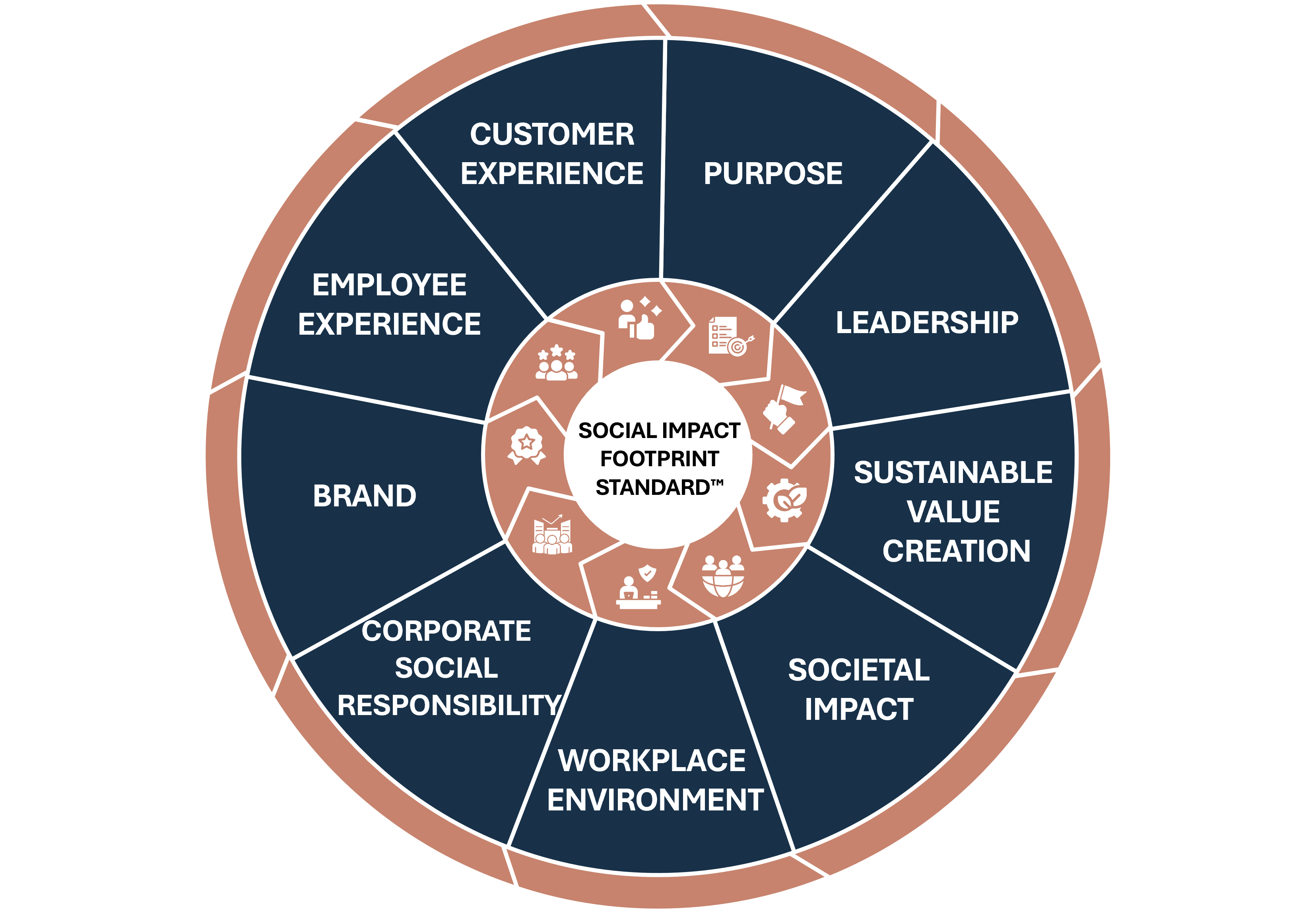
Informed by and aligned with local and global frameworks
Beyond Disclosure
Social value narratives are under scrutiny. Organisations that can independently evidence their social impact will lead the conversation on corporate accountability, ethical leadership, and long-term value. The Social Impact Footprint Standard™ provides the independent, enterprise-level assessment that makes this possible — turning the work organisations are already doing into evidence that boards, investors, and stakeholders can rely on.
One Standard. Two Assessments.
Two complementary assessments, each with a distinct mandate — undertaken separately or together, covering the full social value chain from internal organisational capability to external stakeholder outcomes.
Assessment One
Capability · Maturity · Impact
The Organisational Capability Assessment provides a system-wide view of social impact — connecting the dots across functions and accountability domains, identifying where capability is advanced, where it is developing, and where targeted improvements would deliver the greatest return on the work already being done.
It independently evaluates whether your organisation’s systems, practices, and governance are genuinely capable of producing, delivering, and credibly reporting social value — consistently and verifiably.
The result is a social impact narrative that moves from story to evidence — providing decision-useful insights across your full stakeholder landscape.
Outputs include:
Business-relevant and decision-useful for:
Unlocking strategic business value:
Governance and Reporting
Integrated reporting · Social and relationship capital · King V obligations · Regulatory reporting
People and Brand
Employer brand · Talent attraction · Consumer trust · B-BBEE strategy · Transformation and social equity
Capital and Investors
ESG due diligence · Impact investment · Outcomes-based funding · Development finance · Just Transition
Internal Performance
Balanced scorecard · Executive performance frameworks · Cross-functional alignment · Continuous improvement
Assessment Two
Governance · Evidence · Board Accountability
The Governance Outcomes Assessment independently evaluates whether your governance system is producing verifiable social impact outcomes — giving your board the evidence it needs to stand behind its governance assertions with confidence.
Integrated reporting has transformed corporate accountability — and King V requires boards to demonstrate that governance produces verifiable outcomes, not merely that structures and programmes exist. For social and relationship capital, the evidence has historically rested on management representation.
This assessment closes that gap — producing the independently assessed evidentiary record your board, audit committee, and stakeholders can rely on.
Outputs include:
Business-relevant and decision-useful for:
Unlocking strategic business value:
Governance and Assurance
Board accountability · Combined assurance · Audit committee · Governance system capability
Reporting and Stakeholders
Integrated reporting · Social and relationship capital · ESG disclosure · Stakeholder engagement
Investment and Funding
Outcomes-based funding · Impact investment · Capital allocation · Just Transition
Regulatory and Statutory
Statutory reporting · Governance accountability · Double materiality · CSRD alignment
Are you an Impactful Organization™?
The Impactful Organization™ Designation is how organisations demonstrate they have met that benchmark. Conferred exclusively through independent assessment against the Social Impact Footprint Standard™, the Designation cannot be applied for, purchased, or self-declared.
It is earned.
The Standard applies a five-level Maturity Classification. Organisations that achieve Level 3, Level 4, or Level 5 receive the corresponding Designation:
Level 1
Emerging
No Designation
Level 2
Basic
No Designation
Level 3
Developing
Impactful Organization™ Bronze
Level 4
Advanced
Impactful Organization™ Silver
Level 5
Leading
Impactful Organization™ Gold
The Impactful Organization™ Designation tells your board, investors, employees, and stakeholders what no internal report can: that your social impact has been independently assessed, independently determined, and independently recognised.
The Assessment Process
Beyond Disclosure
Purpose-driven organisations already know that social impact is not just a reporting obligation — it is the expression of what they stand for. Both assessments were built to independently evidence that ambition — giving organisations the systems-level intelligence to understand what they are genuinely achieving, where they can go further, and how to communicate their impact story with the authority it deserves.
About Impact Institute
Impact Institute is an independent assessment authority for social impact governance. Founded by practitioners with deep roots inside South African organisations, we are committed to social transformation grounded in ethical leadership, corporate accountability, and good governance.
Who we are
Our expertise spans executive management, behavioural sciences, human capital, organisational culture, brand, and systems thinking — with a proven track record of driving system change at scale and using data to galvanise stakeholders and drive sustained business performance.
We are not advisors or consultants. Our specialisation lies in quantifying the intangibles of social impact and translating them into decision-useful insights for boards, accountable executives, and practice owners. We provide the missing structural layer in corporate accountability: independently assessed, data-led intelligence that makes social impact performance substantiated, comparable and strategically valuable.
Why this matters
For too long, the S in ESG has been running on narrative. Environmental performance has science-based targets, carbon accounting, and third-party verification. Governance has external assurance and audits. Social performance has relied on self-reported stories, employee surveys, diversity metrics and CSR spend.
That is no longer defensible. King V requires boards to demonstrate verifiable governance outcomes. Investors and consumers are asking harder questions. The Just Transition demands that organisations balance environmental and social value chains while delivering shareholder returns and ensuring societal well-being — providing independently evidenced answers to the question stakeholders are now asking:
Beyond narrative, can you evidence the social outcomes you claim?
Our contribution
We identified that gap, and spent two years researching, engaging, and building. The result is the Social Impact Footprint Standard™ — the first independently peer-reviewed standard to assess social impact at enterprise level.
It is not a reporting framework. Not a ratings methodology. Not a checklist. It is an independent assessment standard — grounded in South Africa's business and social context, aligned with global frameworks, and built for the complexity of real organisations operating across real communities.
For the first time, the S is quantifiable, comparable, and independently evidenced. Boards gain verified governance outcomes. Investors gain credible, comparable metrics. Organisations genuinely creating social value gain the tools to prove it.
Our place in a longer story
Every global standard began with a belief that things could be done better. Carbon accounting started with environmental impact. The GRI began with the belief that organisations should account for more than financial returns. Integrated reporting started in South Africa, with the conviction that the full story of value creation needed to be told.
South Africa has always been at the frontier of governance innovation. Our complex social challenges, pioneering shared-value approaches, and a governance heritage rooted in social justice have laid the foundation for a new global standard for social impact.
And much like carbon accounting catalysed environmental accountability, we believe the Social Impact Footprint Standard™ will set a new benchmark for credible, quantitative social impact measurement.
Beyond Disclosure
Businesses do not exist in isolation. They depend on communities, employees, customers, and the societies that sustain them. That relationship carries an obligation: not just to report on social impact, but to understand it, evidence it, and be accountable for the difference it makes.
We believe that when organisations are equipped to know better, they can do better. Our work is to give them the tools to meet that obligation honestly, rigorously, and verifiably.
Social transformation is a collective responsibility. The most meaningful shift happens when organisations choose to hold themselves to a higher standard — not because they must, but because they understand that no business succeeds in a society that fails.
Get in touch
Impact Institute is an Independent Assessment Authority for Social Impact Governance.
Beyond Disclosure.
If you'd like to:
You can also reach us directly at info@impactinstitute.co.za
Follow us on LinkedIn